
The Big Fear Holding Buyers Back: What If Home Prices Drop?
It is easily one of the biggest hesitation points in today’s real estate market. You hear it from friends, family, and all over the news: “What if I buy a home right now, and prices go down?”
It’s a completely fair question. No one wants to sign a contract on a major financial milestone only to feel like they timed it wrong. If you are a first-time buyer, that anxiety can feel even heavier.
But if you are getting hung up on headlines detailing slight, isolated price dips in a few specific markets, you are missing the forest for the trees. To understand where real estate is going, you have to zoom out and look at the bigger picture.
What 70+ Years of Data Really Shows
When you look past the weekly news cycle and study the historical data, a very different story emerges. Famed market analysts Case-Shiller and Charlie Bilello tracked year-over-year U.S. home price changes all the way back to the 1950s.
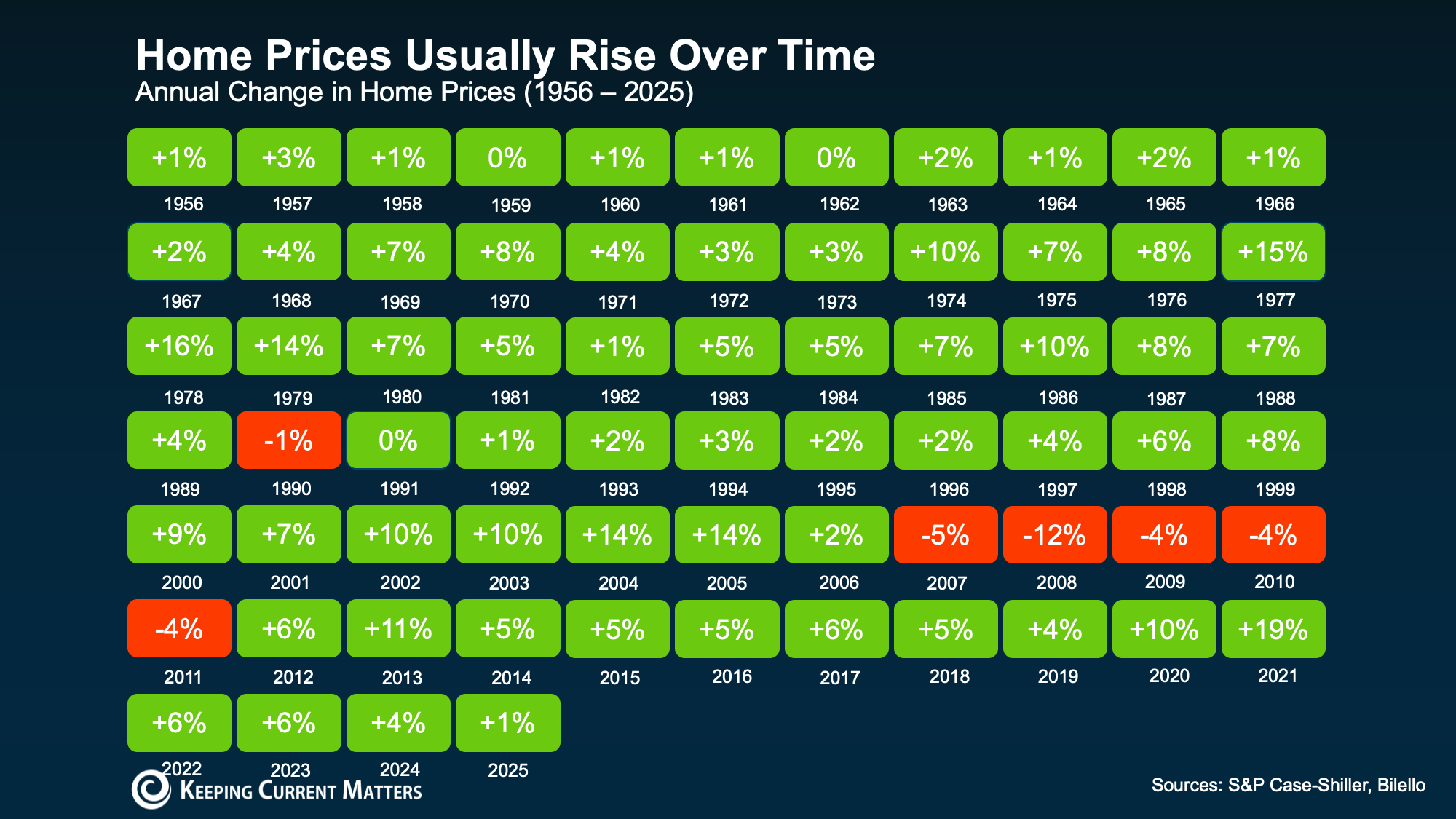
The key takeaway is unmistakable: Outside of the 2008 housing crash, national home prices have either held steady or increased in almost every single year for decades.
Real estate has shown a remarkably consistent track record. While short-term volatility can happen, it’s the long-term appreciation that builds true wealth.
Why Home Prices Tend to Rise Over Time
This consistent growth isn't a fluke. It is driven by three foundational pillars of economics that don't just disappear during market shifts:
Persistent Demand: People always need a place to live. Life keeps moving—families grow, people relocate for work, and households downsize. While buyer demand may ebb and flow with interest rates, the baseline need for shelter never goes away.
The Inventory Deficit: Even though we’ve seen a welcome increase in homes for sale recently, the housing market remains fundamentally undersupplied on a national level. There are simply more people who want homes than there are roofs available, keeping consistent upward pressure on values.
The Reality of Inflation: Over time, the cost of goods, labor, and materials naturally increases. Because a home is a physical asset made of those exact materials, its value inherently rises alongside everyday living costs.
What This Means for You as a Buyer
Does this mean prices go up every single year in every single neighborhood? No. Real estate is hyper-local. Short-term ups and downs are normal, and we are seeing some localized corrections right now.
However, history proves that these declines are almost always temporary.
This is exactly why real estate is traditionally viewed as a long-term investment. If you plan to own and stay in a home for a while—typically at least five years—you give yourself a wide enough window to easily ride out any temporary market ripples. Over that time, those rising home values compound, growing your net worth and quietly building your equity.
The goal shouldn't be to time the market perfectly—because even the experts can't do that. The goal is to make a move that aligns with your life, your budget, and your personal timeline, allowing the historical strength of the market to do the heavy lifting for you.
Bottom Line
Home prices have a multi-decade track record of appreciation. If buying a home makes sense for your lifestyle and your budget right now, history says it remains one of the safest long-term investments you can make.
You shouldn't force a move until you're ready. But if you’re waiting purely out of fear of a sudden market crash, let the data give you some peace of mind.
Want to take a closer look at what home prices are doing right here in our local market? Let's connect to look at the local numbers and map out a timeline that works for you.
