

The 40% Club: Why Real Estate’s Biggest Guessing Game Is Costing Sellers Thousands
Most homeowners walk into a sale with one specific number burned into their brains: their asking price.
It makes sense. You’ve put years of love, sweat, and mortgage payments into your home, and you want to walk away with a win. A recent survey from Realtor.com shows that roughly 80% of sellers expect to hit or exceed that target number when they list.
But there’s a massive disconnect happening in today's housing market.
In reality, only about 40% of sellers are actually getting their asking price or more. That means 6 in 10 homeowners are getting caught off guard by a market that refuses to play by the old rules.
So, why the gap? And more importantly, how do you position your home to become one of the coveted 4 in 10 that walks away with top dollar? Let’s break it down.
Welcome Back to Reality (Why 40% Isn't Actually Bad News)
If you’ve been watching the news, a 40% success rate for asking prices might sound like a market crash. It isn't.
What we are witnessing right now is simply a return to a healthy, normal real estate market. If you look back to 2019—the last "normal" year before the world went sideways—only about 20% to 30% of homes sold above list price. Today’s numbers are actually a slight improvement on those traditional baseline years.
The problem is psychological. Between 2020 and mid-2022, buyer demand was artificially sky-high and housing inventory hit historic lows. Everything sold over asking, often within hours, regardless of condition.
But the rules of 2021 no longer apply. Today, buyers have more options, more time, and much higher standards. To cash in big, you have to meet the market where it actually is, not where it was three years ago.
The "Room to Negotiate" Myth
When listing a home, it’s incredibly tempting to price it high just to "see what happens" or to give yourself some bargaining chips. In today’s market, that strategy backfires spectacularly.
Modern buyers don't look at an overpriced home and think, "Let me offer $30,000 less." Instead, they just click next.
Buyers are hyper-aware of local values. If your home doesn't align with similar properties in the neighborhood, it won't even get a showing. When that happens, a dangerous snowball effect begins:
High Price - Fewer clicks and zero foot traffic.
Zero Traffic - No offers.
No Offers - Extended days on market.
Data from across the country proves that homes priced at or slightly under current market value sell fast. Homes priced even 5% too high sit. And in real estate, time is money.
The Price Cut Trap
When a home sits on the market for too long, sellers inevitably turn to the price reduction. Right now, about 17% of sellers are taking this route.
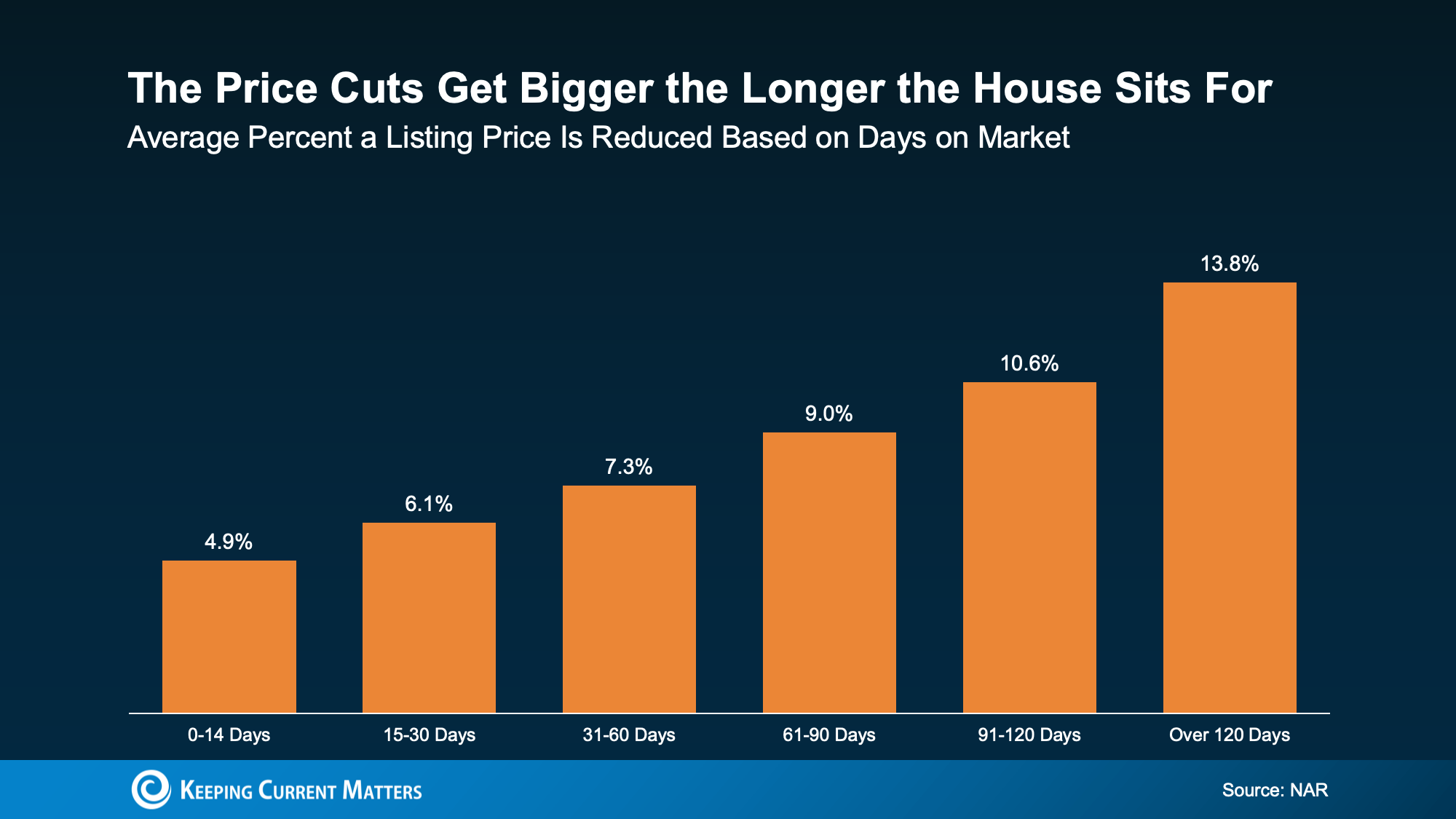
But a price cut is rarely a clean slate. It often triggers a psychological trap for buyers:
The Buyer's Doubt: When buyers see a home that has been sitting for 60 days with a fresh price drop, their first thought isn't "What a deal!" Their first thought is "What's wrong with that house?"
According to data from the National Association of Realtors (NAR), the longer a home sits, the steeper the final price cut has to be just to catch a buyer's attention. What started as a strategy to "leave room for negotiation" frequently ends up forcing the seller to accept far less than they would have received if they had just priced it right on Day One.
Finding the "Goldilocks" Sweet Spot
Listing at—or even a hair below—market value might feel counterintuitive when your goal is to make the most money possible. But psychology proves it’s the most lucrative strategy you can use.
The goal of listing your home isn’t to see how high a price you can print on a yard sign. The goal is to create a bidding war.
NAR describes the ideal strategy as a "Goldilocks" frame of mind:
Too high: Buyers disappear.
Too low: Buyers assume it needs a new roof and a foundation repair.
Just right: You create immediate buzz, packed open houses, and a sense of urgency.
When multiple buyers fall in love with a correctly priced home at the exact same time, competition drives the final sales price up. That is how you break into that elite 40% club.
The Bottom Line
Pricing a home today requires a scalpel, not a sledgehammer. You cannot test the waters with an inflated price and expect to negotiate your way down to a victory later.
If you want to maximize your profit and sell on your timeline, you need an expert who understands what local buyers are actually writing checks for this week.
Ready to find your home’s financial sweet spot? Let’s connect. We’ll look at the real-time data in your neighborhood to ensure your home stands out, creates competition, and wins from the very first day it hits the market.
